John Peter Koger is my 5th Great-Grandfather. He was born September 17, 1753 in Hawksbill River, Rockingham County, Virginia. {There are so many documents relating to John Peter Koger, especially regarding his involvement in the Revolutionary War. It would be impossible to collect them all here, but I have tried to organize those that I deemed most informative.}
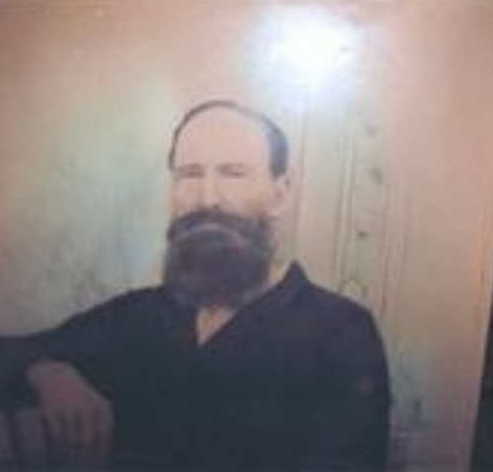
(excerpts of a letter from the late Dr. Okey Cogar, Professor of History at West Virginia University, Morgantown, West Virginia, dated April 1, 1980):
It is unlikely that Peter Coger was born on the Hawksbille of the Shenandoah in Virginia, because “Jacob Koger sold his Hawksbille property to John Megert on September 21, 22, 1743.Peter states that he was born in 1753.At that time Hans Jacob was living at the Lower Page Bottoms, a beautiful 10 acre tract that he purchased from Richard Mauldin in 1743, and rounded out with a grant in 1753.This land lies about 15 miles south of Luray, Virginia, on the Shenandoah River.”
Concerning why Peter Coger was raised in Rockingham County, Virginia, when Jacob Koger was living in Henry County, “… the land in Rockingham County was originally purchased from Mauldin, but a faulty deed was granted.The land was resurveyed in 1755, and granted to Jacob “in total” by a Crown Patent.Jacob was in Halifax Territory, later Henry County, and had land surveyed there in that year.He subsequently received a patent for the Henry County land, and moved there.
“Granted or Patented land was not a gift in any manner.Certain stipulations applied, the two most severe being a “quit-rent” that had to be paid to the crown each year, and the other, the real back-breaker, was the stipulation that so many acres had to be put under cultivation each year.This latter is the reason that most grants were modest in size before the Revolution; only land speculators such as the above mentioned Mauldin went for large tracts, and then they had to sell them rapidly or lose them.
He served in the Revolutionary War as a Private in Virginia. This is recorded on page 58 of “West Virginians in the American Revolution”.

There is also documentation of his required deposition. It reads:
This is the first page of the required court deposition for anyone wanting to obtain a pension. This is my own poor transcription: “State of Virginia, Lewis County. On the 3rd day of December, AD 1832, personally appeared in open court before the justices of the court now sitting Peter Coger residing in the county of Lewis in the state of Virginia aged 79 years who being first duly sworn according to law doth on his oath make the following declaration in order in order to obtain the benefit of the Act of Congress passed June 7, 1832. That he entered the service of the Unted States under the following named officers and served as herein stated. In Rockingham County in the state of Virginia on the 1st July 1777, he volunteered as a private in the company commanded by Capt Jeremiah Ragen, ____ (blank line included in the original) Harrison, Lieut Ensigns name forgotten. March from thence through Augusta and Greenbriar (?) counties to the Great Kanawha River and descended to Point Pleasant at its mouth. When he arrived the fort was garrisoned by Col. Skillern troops. He seen when there Capts Arbuckle, Stewart and Hill. Cornstalk the celebrated _____ (an Indian Chief) was at this time detained at the fort as a hostage together with Red Hawk and some other Indians of distinction. Was at Pt Pleasant when the affair took place which ____ the death of the Indian hostages. ___ Cornstalk, Red Hawk and Eleuipsiea (?) shot by the inclosed soldiers. Declared ___ at the fort of Pt Pleasant awaiting the arrival of Genl Hand from Fort Pitt with whose forces they expected…” This page ends here.
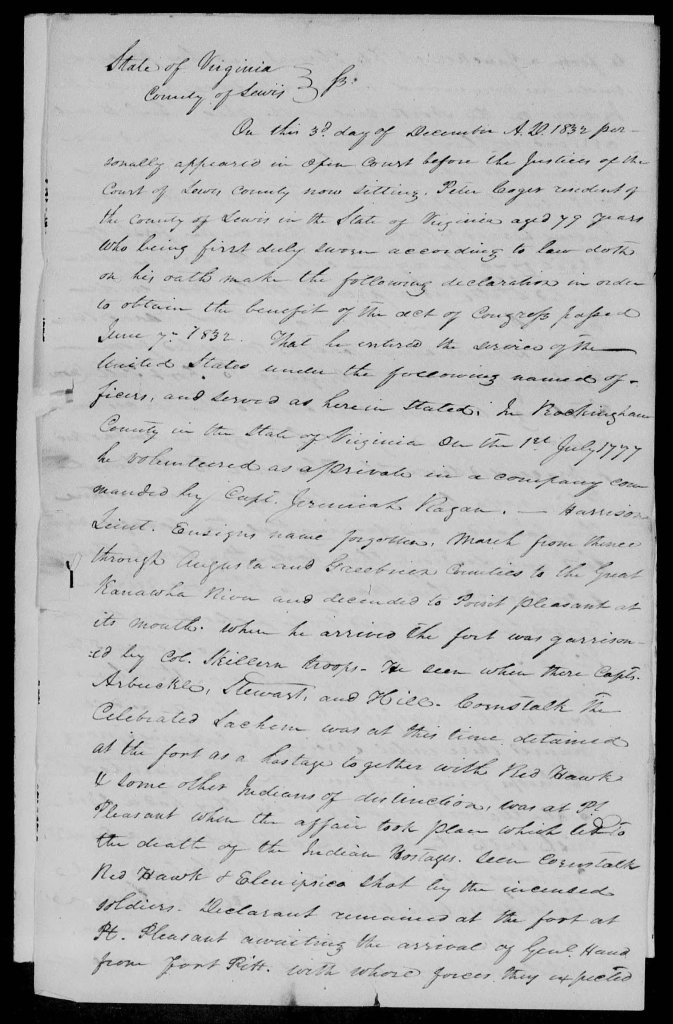
This is the second page of the required court appearance deposition of Peter Coger: “to form a junction at Ft Pleasant and then proceed under his command on an expedition against the Indians on the north side of Ohio. Genl Hand arrived without an army and the expedition was abandoned and declared (Peter Coger) was in January 1778 discharged by his captain. He returned home having served 7 months. Then on the first of April 1779, he again entered the service of the United States as a private volunteer under Capt Abraham Bowman, Liet Isaac Bowman, Daniel Dust Ensign. Marched from Rockingham County Virginia to Fort Pitt (now Pittsburgh) was there attached to forces under command by Col GR Clark. Embarked and proceeded down the Ohio River –there they landed– and fearing that the savages might find and destroy their boats, they sunk them and continued their march to Illinois River. Part of the forces were stationed here during the winter the other part went up the Mississippi to Coho (? probably Ohio) station and remained there until spring. In following spring troops formed a junction and marched to the Wabash County where they had a skirmish with the French and Indians a small company who was taken Capt Helmn and his soldiers who were from Old Virginia a battle took place, firing kept up during whole night we wounded and killed some of….” this is where this portion of the deposition ends.

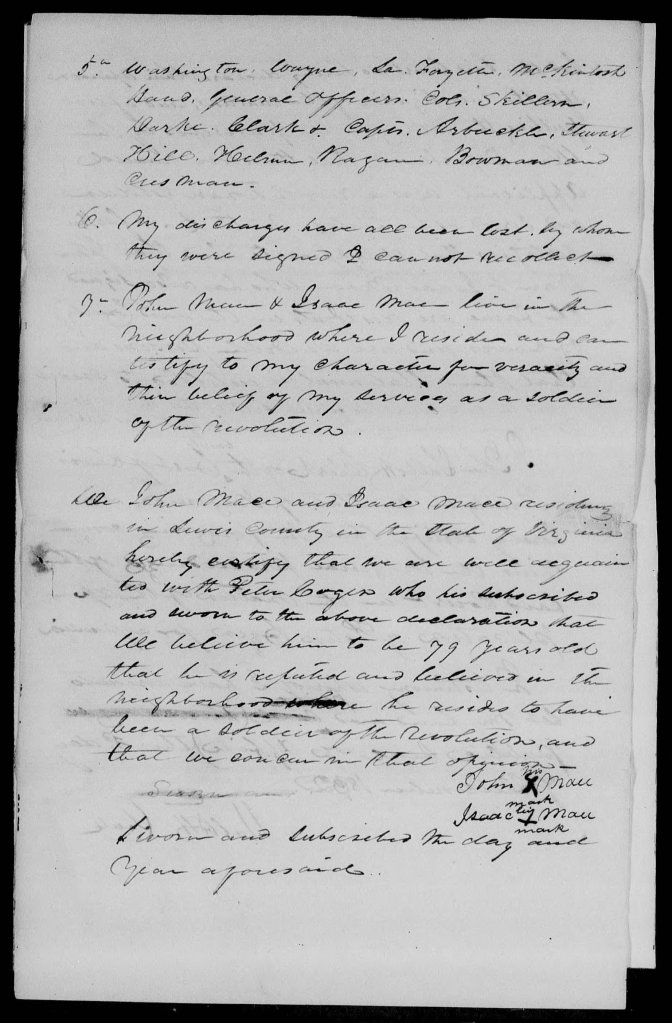
The required deposition of Peter Coger: “5th Washington, Wayne, LaFayette, MacIntosh, Hand, General Officers, Cols Skillern, Darke, Clark and Capt Arbuckle, Stewart, Hill, Helmn, Ragan, Bowman and Cressman. 6th My discharges have all been lost by whom they were signed I cannot now recollect. 8th John Mace and Isaac Mace live in the neighborhood where I reside and can testify to my character for veracity and ___ belief of my services as a solider of the revolution. We, John Mace and Isaac Mace, residing in Lewis County in the state of Virginia hereby testify that we are well acquainted with Peter Coger who is subscribed to the above declaration that we believe him to be 79 years old that he is reputed and believed to be in the neighborhood where he resides to have been a soldier in the revolution and that we concur in the opinion, (Signed and Marked) John Mace (Signed and Marked) Isaac Mace Sworn and subscribed this day and year aforesaid.” This ends this page of the deposition.
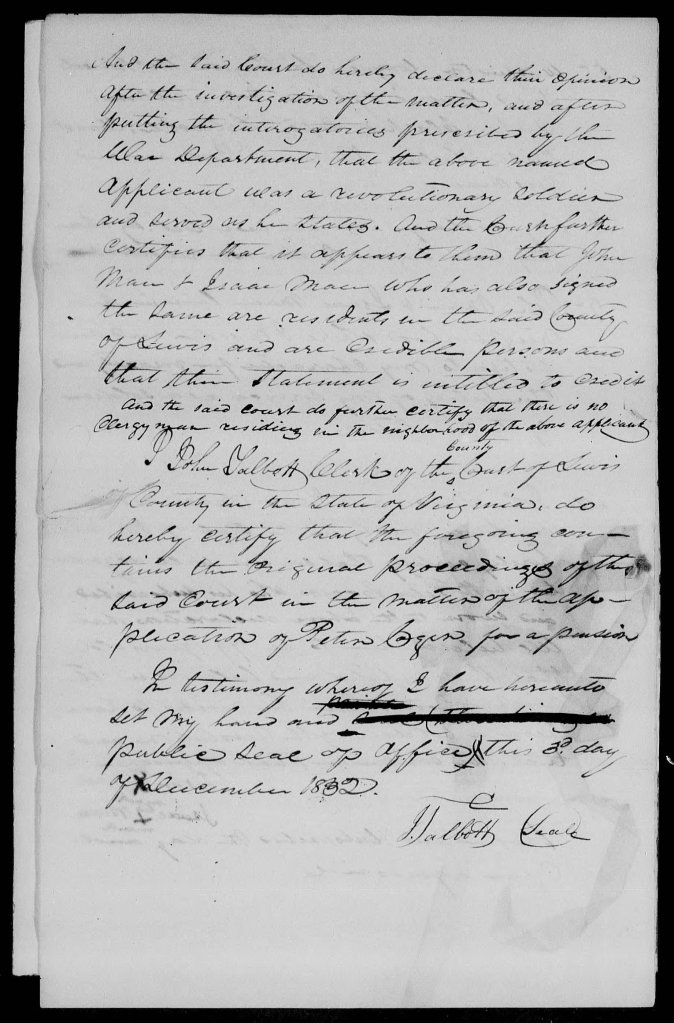
The last page of the required deposition of Peter Coger, it is continued and reads: “And the said court do hereby declare their opionion after the investigation of the matter and after putting the interrogations proscribed by the War Department that the above named applicant was a revolutionary soldier and served when stated. And the court further certifies that it appears to them that John Mace and Isaac Mace who has also signed the same are residents in the said county of Lewis and are credible persons and that the statement is entitled to credit and the said court do further certify that there is no clergy man residing in the neighborhood of the above applicant. I John Talbott clerk of the court of Lewis County in the state of Virginia do hereby certify that the foregoing contains the orginal proceedings of the said court in the matter of the applicaton of Peter Coger for a pension. In the testimony whereof I have hereunto set my hand and (scirbbled out) public seal of affixed this third day of December 1832. (Signed and Sealed) John Talbott” This ends the required deposition of Peter Coger.
Page 11:
Page 12:
Page 40:
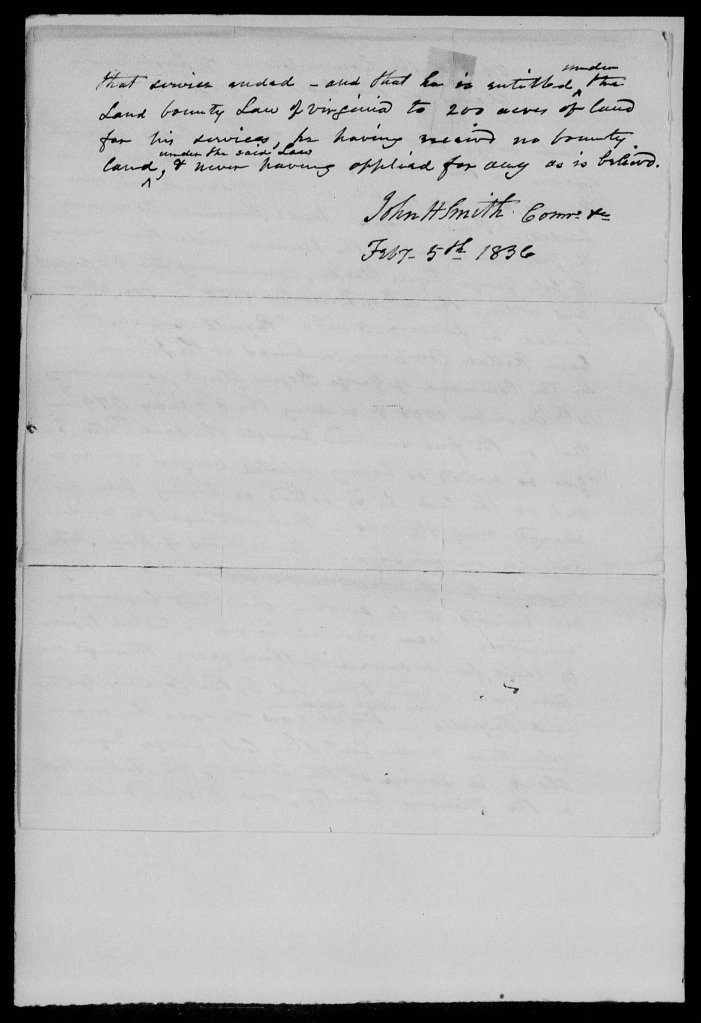
This is the tail end of a lengthy document (page 38) and is one of several documents that Peter Coger signed in his own hand, as opposed to someone else signing his name and him making an “X” as his mark of authenticity:
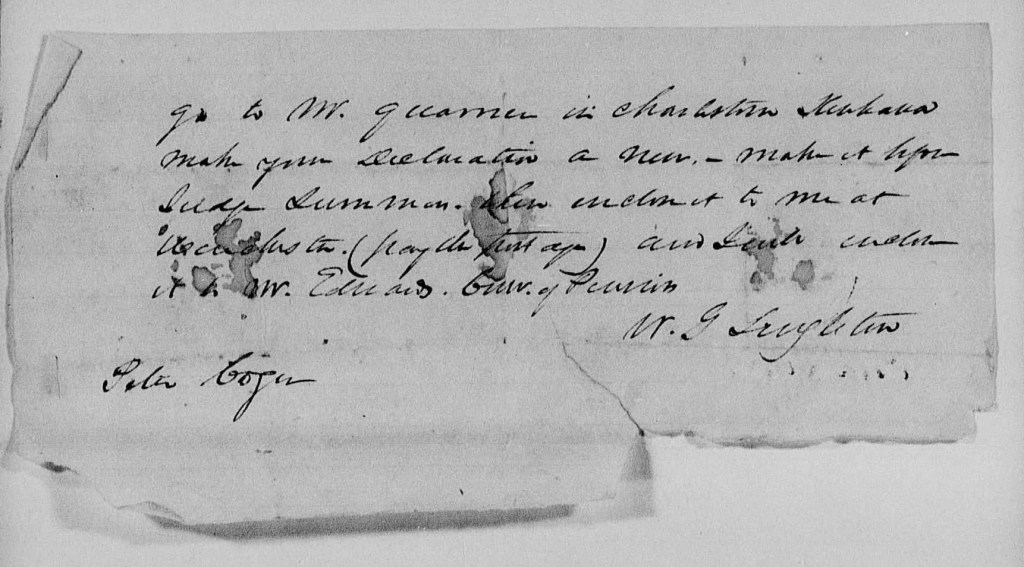
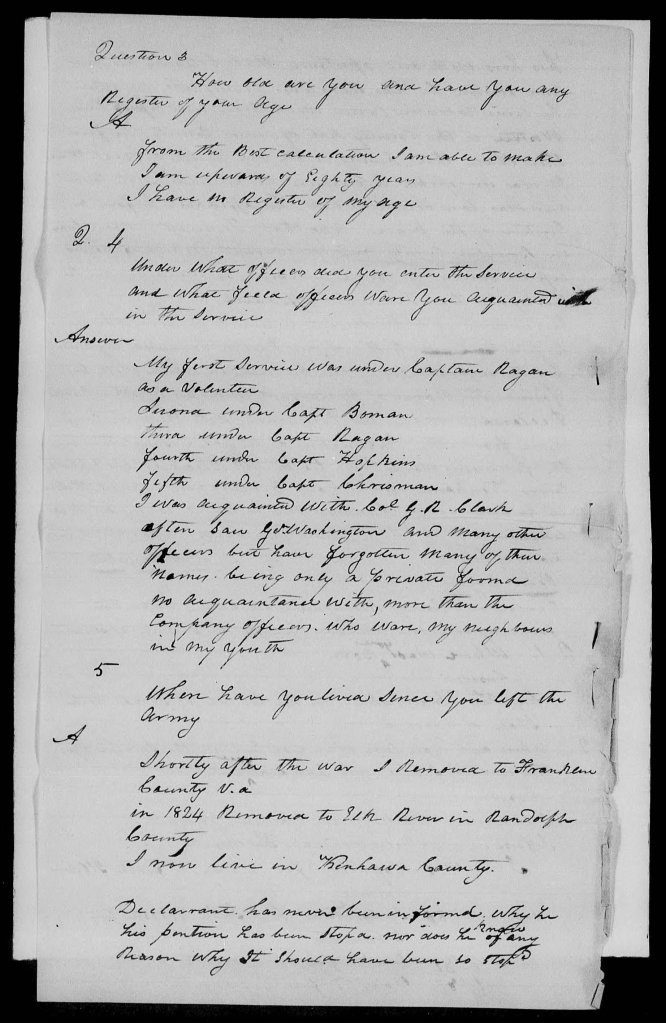
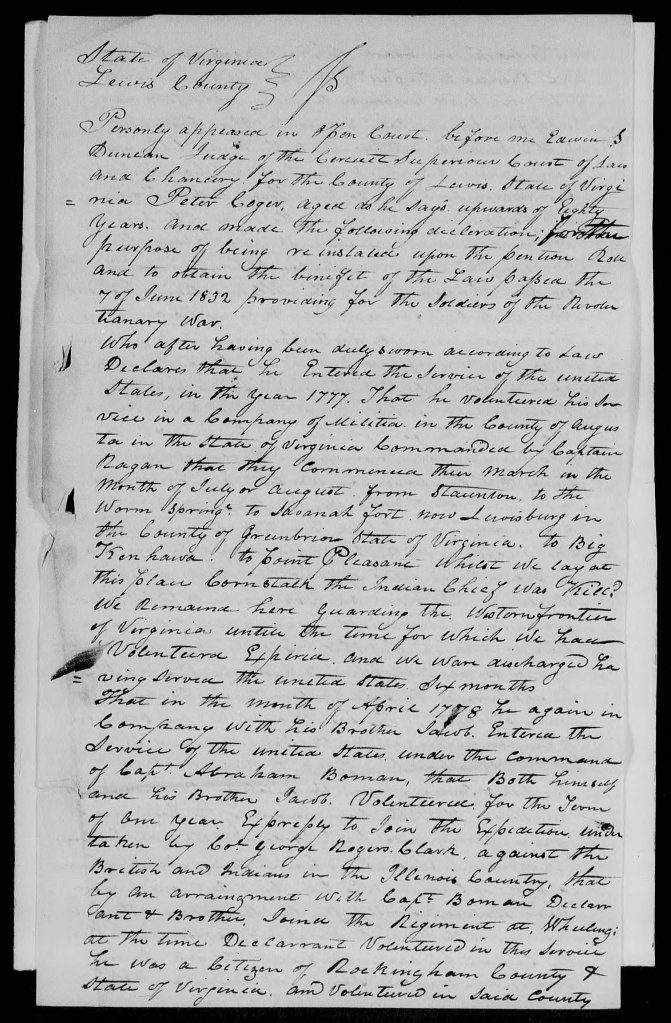
Information obtained from Mr. Anderson, http://www.geocities.com/SiliconValley/Circuit/6495/bea/pafg05.htm.
Peter enlisted in the RevolutionaryWar from Rockingham County, VA. He served as a private in the company of Capt. Ragan and Lt. Harrison in the regiment of Col. Skillern, his service extending from 1777 to 1781. He was at Point Pleasant when Chief Cornstalk was killed. Served underGen. George Rogers Clark in his historic conquest of theNorthwest Territory in the Illinois Expedition. Peter also served during the siege of Yorktown and the British surrender there in 1781. He applied for pension from Lewis County, VA, December 3, 1832,and in support of his claim are affidavits of John and Isaac Mace, Tunis McElwain, and Robert Hamilton. He names a long list of Revolutionary officers with whom he had seen service. He served in the militia on several occasions, once under Capt. George Cresman Rockingham County, VA. Bought land from Jeremiah Carpenter and obtained a land grant from the Commonwealth of Virginia for a larger tract.U.S. Revolutionary War Pension Records for Lewis County, VA, list Peter as age 81 in 1833, and living with Adam Starcher. Adam Starcher was married to Peter’s daughter, Phoebe.
Early in the spring of 1780 Peter Coger substituted for a tour of three months in the place of John Keiser in a company of militia in Rockingham County commanded by Captain Jeremiah Ragan.
“We marched to the lower part of Virginia marching through Richmond.The occurrences of the campaign has principally passed out of his recollection, but he recollects that on one occasion himself and 10 or 12 others of the men stopped in a field to pick blackberries, that while so engaged a small squad of British Light Horsemen attackedbut being fired upon ceased to pursue us and we made the best of our way to the regiment who had halted on hearing the sound of the guns.
“We explained and marched on and crossed the Appomattox River—in crossing the boat capsized and one man was drowned.(On reaching Frederixbourg) declarant was discharged having served three months.”
Peter Coger was drafted immediately on reaching home, and marched to the area below Richmond, in North Carolina, where theyremained guarding the country for three months.
Then in the Spring on 1781, he was drafted again for the last time, and took part in the seige of Lord Corwallis’ troops at Yorktown.
When he was 27, he dealt with the passing of his mother, Lucinda Myra Crum (b. 1710 – d. 1781). That same year – September 3, 1781 – he married Mary Polly McElwain. Just two years later his father passed away – Hans Jacob Koger, Sr (b. 1710 – d. 1783).
On page eight of the Book of Marriage Bonds of Rockingham County, Virginia, for 1778-1816, is the following entry:
“I do hereby certify that Peter Coger and Mary Mackelvain were Lawfully Married by Publishment, Given under my hand
September 3, 1781.
Anderson Moffett
1791—5th year of the Commonwealth.
Shortly after their wedding, Peter and Mary moved to Franklin County. Peter Coger was given a deed in Franklin County on the 13th Day of November 1793, for 97 1/2 acres of land.
In a letter from James B. Koger to Steve Coger dated February 9, 1985, James B. Koger states:
“The last I heard from Okey Cogar was something very interesting. He said that he had come across records back in Virginia that when Michael Coger sold the land that had been deeded to him by his father Jacob Koger, before he (Michael) left for Kentucky to take up his land grants there, that he divided his proceeds with his brothers Peter and Jacob Koger, Jr. It was with this money that both Peter and Jacob, Jr. could buy property and set up living in Franklin County, Virginia. I asked him where I could find these documents, but never got an answer. I did hear that he had been sick, but that is all I know.”
In 1782, on the 21st of October, Peter Coger signed as a witness on a deed from his father Jacob, giving land on Stone’s Creek in Henry County to his brother, Jacob’s son Henry.
On April 3, 1797, records state that he purchased 160 acres of land on the Blackwater River in Franklin County.
A letter from James B. Koger to Steve Coger, dated September 21, 1980, states,
“Okey Cogar states that Peter had several slaves and when he moved to Franklin County, he took them along with him.”
In two separate actions, Peter Coger and his wife Mary, cited as Polly, gave away 200 acres, 100 each time, in February of 1816: 100 acres on Blackwater River, and the other hundred simply listed as in Franklin County.Neither listing states to whom the land was given.
Book One of Land Grants in Nicholas County, Virginia, on page 135, states;
“Cogar, Peter65 acres at White Elk in year of 1823.”
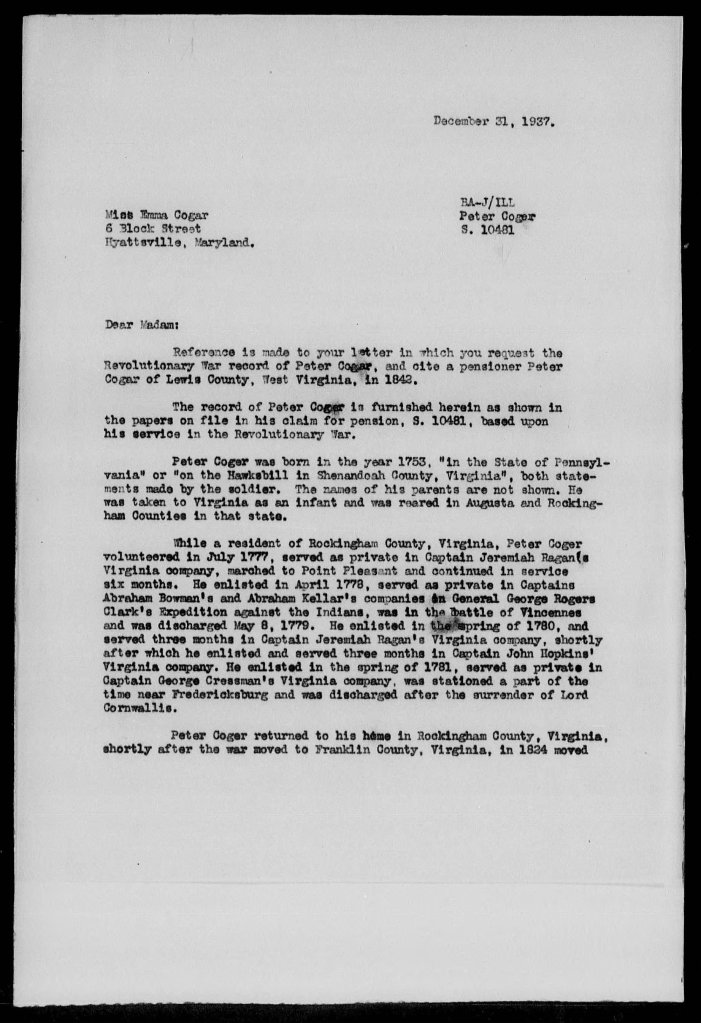
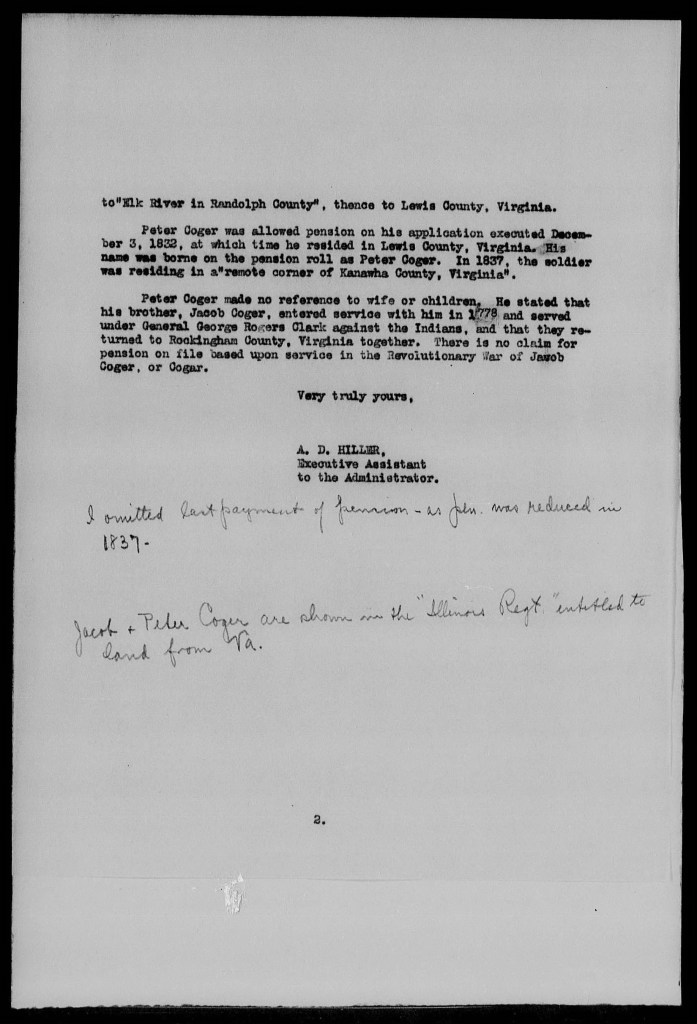
According to a letter written from the Veteran’s Administration to Miss Emma Coger in 1937, government records show that in 1824, Peter and his family moved to the White Elk River in Randolph County, and then to Lewis County, Virginia.
By comparing the Census Records for the period with the moves of Peter Coger and his family, we can, with some certainty, tell which of the Cogers later living in this region were the children of Peter and Mary “Polly” Coger.Their son William was born around 1782; Jacob was born about 1783; Thomas about 1788; Peter, Jr., about 1790; Benjamine, about 1793; and John, about 1797.Their only daughter whose name has come down to us is Catherine, but her birth date is unknown.There may have been other daughters, but we have no records to indicate their married names.We do know that Peter Coger was allowed a pension on his war service, and that it was executed December 3, 1832, at which time he was living in Lewis County, Virginia.
In 1837 Peter Coger was residing in a remote corner of Kanawha County, in what is now West Virginia.
A pension list of Revolutionary War soldiers still receiving pensions in 1841 lists Peter Coger as living in Lewis County, Virginia, with an Adam Starcher, who was apparently one of his son-in-laws.
According to a book on the McElvain family by Delores Cogar Bright of Woodbridge, Virginia, Phoebe Coger, the tenth child of Peter Coger and Mary McElwain married Adam Starcher on August 28, 1828 in Kanawha County, now Calhoun County, West Virginia.
Mrs. Bright lists that Adam and Phoebe were the parents of nine children: 1.Sarah (Sally) Starcher married Asa Hamrick; 2. Thomas Starcher was killed shortly after the beginning of the Civil War; 3.Jacob Starcher was first married to Minerva Stahlman and second to Margaret Coger; 4. William Starcher died on February 1, 1866; 5. Henry Starcher married 1st Sara Elizabeth Slider and 2nd Matilda Greathouse; 6.Peter Simon Starcher married Sarah Wilson; 7. John (Jehu) Starcher married Susanna Kirby; 8. Mary (Polly) married John Bailey; 9. Elizabeth (Betty) married George
William Gibson.
Adam Starcher and Phoebe Coger and most of their children are buried in the Gibson Cemetery near Arnoldsburg, West Virginia on the West Fork.
The year 1786 brought celebration with the birth of son Thomas (Jefferson) Cogar in Botetourt, Virginia. Then in 1790 my grandfather, Jacob Cogar, was born in Franklin County, Virginia. Another son, Benjamin G. Coger, was born in 1795.
The 1810 Federal Census lists the family as still residing in Franklin County, Virginia:
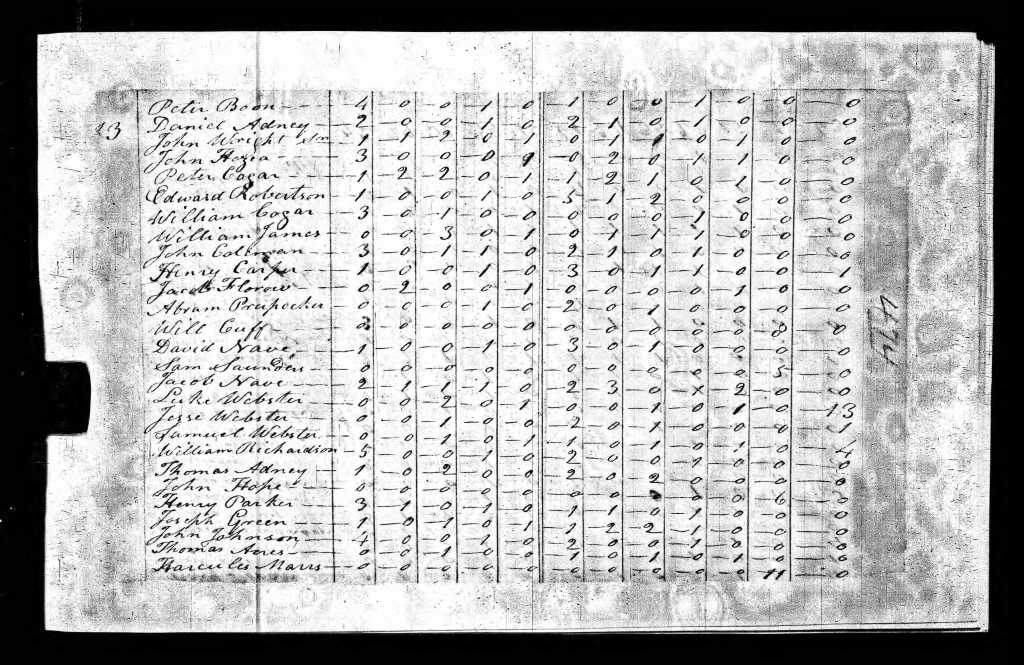
Upon the death of his wife, the family was in Randolph County, Virginia, which is now Braxton County, West Virginia. This is corroborated on the 1830 Federal Census:
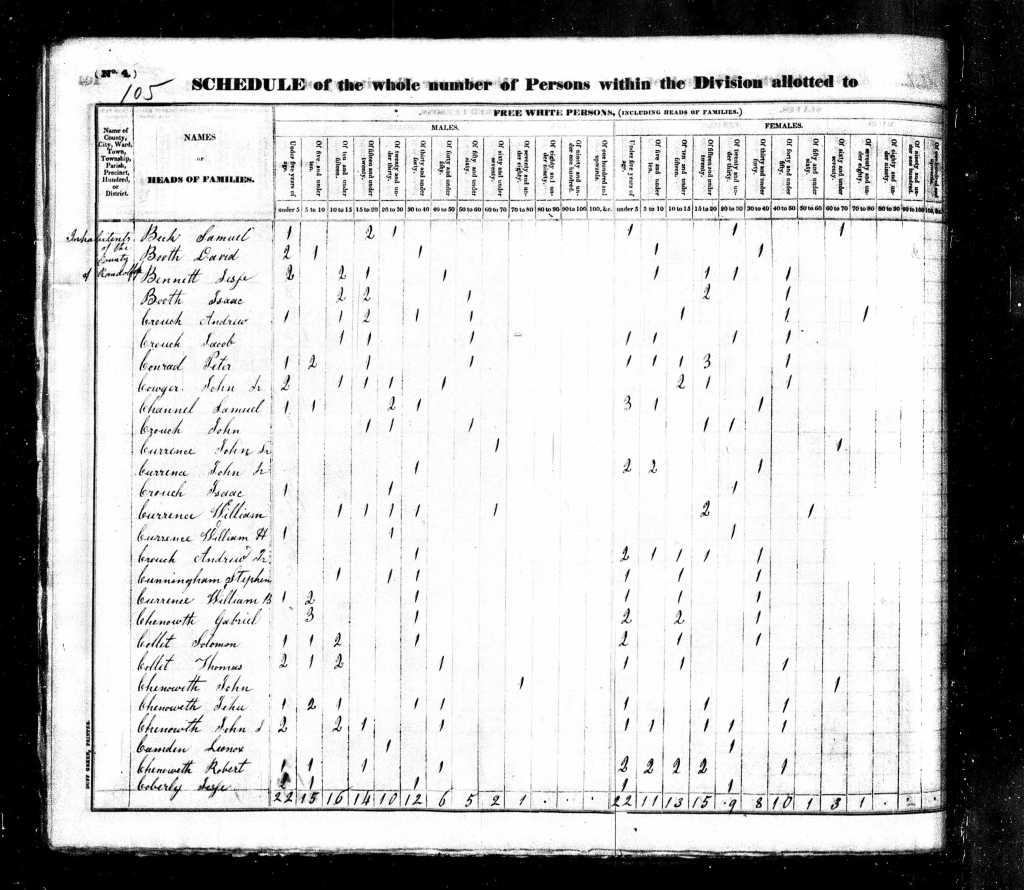
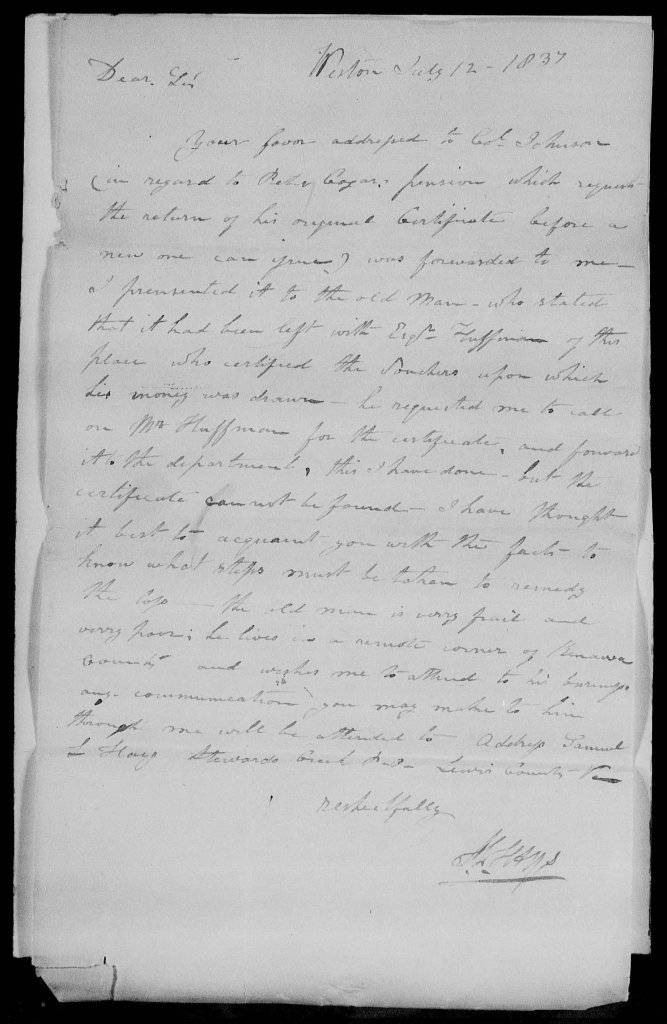
The following is a letter from 1837 that reads:
Weston, July 12, 1837 Dear Sir, Your form addressed to Col Johnson in regard to Peter Coger pension which requests the return of the original certificate before a new one issued, was forwarded to me. I presented it to the old man–who stated that it had been left with Esq Huffman of the place who certified the vouchers upon which his money was drawn–he requested me to call on Mr Hoffman for the certificate and forward it to the department–this I have done but the certificate cannot be found. I have thought it best to acquaint you with the facts to know what steps must be taken to remedy the loss–the old man is very frail and very poor; he lives in a remote corner of Kanawha County and wishes me to attend to his ____– communication you may make to him through me would be attended to–______ Samuel L Hays Stewards ____ Lewis County Virginia Respectfully (Signed) Samuel L Hays”
John Peter Koger died September 3, 1841 in Braxton County, Virginia.
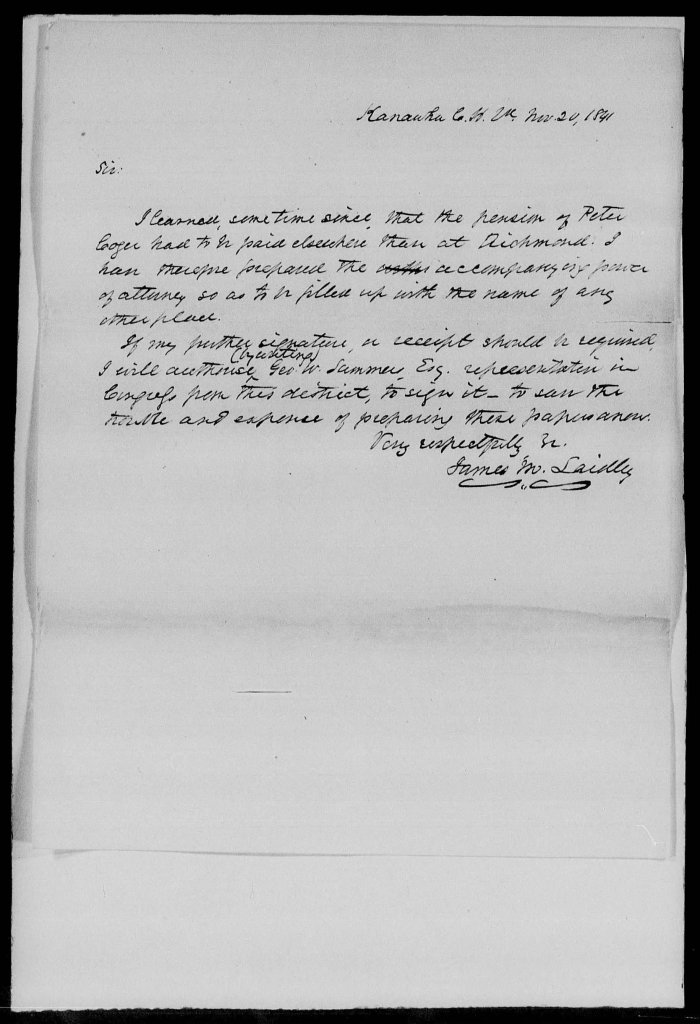
This is the 1840 Letter of Transfer Inquiry:
This letter is difficult to make out: (I believe the header is) “Kanawha City, Harrison County, Virginia, Nov 20, 1841 Sir, I learned sometime since that the pension of Peter Coger had to be paid elsewhere than at Richmond; I have ___ prepared the accompanying power of attorney so as to ____ up with the name of any other place. If my ____ signature a receipt should be required I will authorise (sic) by writing Geo. W Summers Esq., representative of Congress from this district to sign it, to save the trouble and expense of preparing these papers anew. Very respectfully yours, (Signed) James M. Laidley”
The following represents, verbatim, three letters dictated by Peter Coger in which he recalled his service to his country, both before and during the American Revolution.These letters were dictated late in Peter Coger’s life expressly for the purpose of obtaining a government pension, which was subsequently granted.As much as possible, the original spelling punctuation have been retained.Blank spaces indicate illegible words.
State of West Virginia
County of Lewis
On this 3rd day of December A.D. 1832 personally appeared in open court before the justice of the Court of Lewis County now setting, Peter Coger resident of the county of Lewis in the state of Virginia aged 79 years who being first duly sworn according to law doth on his oath make the following declaration in order to obtain the benefit of the Act of Congress passed June 7, 1832.That he entered the service of the United States under the following named Officers, and served as herein stated.In Rockingham County in the state of Virginia on the 1st July 1777 he volunteered as a private in a company commanded by Capt. Jeremiah Ragan.¾ Harrison Leiut. Ensign name forgotten.March from thence through Augusta and Greenbriar Counties to the Great Kanawha River and descended to Point Pleasant at the mouth.When he arrived the fort was Garrisoned by Col. A. Kellars troops.He seen when there Capts. Arbuckle, Stewart, and Hill.Cornstalk the celebrated Sachem was at this time detained at the fort as a hostage together with Red Hawk and some other Indians of distinction, was at Pt. Pleasant when the affair took place which led to the death of the Indian hostages.Seen Cornstalk, Red Hawk, and Eleuipsica shot by the incensed soldiers.Declarant remained at the fort at Pt. Pleasant awaiting the arrival of Genl. Hand from Fort Pitt with those forces they expected to form a junction at Pt. Pleasant and then proceed under his command on an expedition against the Indians on the North side of the Ohio.Genl. Hand arrived without an army and the expedition was abandoned.and Declarant was in January 1778 discharged by his Capt. and returned home having served 7 months.Then on the first of April 1779 he again entered the service of the United States as a private volunteer under Capt. Abraham Bowman, Leiut. Isaac Bowman.Daniel Dust Ensign.Marched from Rockingham Co., Va., to Fort Pitt (now Pittsburgh) was there attached to the forces under command of Col. G.R. Clark, embarked and proceeded down the Ohio river to the Burnt Chimneys below the Falls of the River¾there they landed¾and fearing that the savages might find and destroy their boats¾they sunk them and continued their march to the Illinois river¾crossed the same and took possession of the Illinois Fort.Part of the forces were stationed there during the winter.the others went up the Mississippi to Coho Station and remained there until spring.The following Spring the troops formed a junction and marched to the Wabash Country, where they had a skirmish with the French and Indians, a small company who had taken Capt. Helm and his soldiers, who were from Old Virginia, a battle took place, firing kept up during a whole night, we wounded and killed some of the French and Indians and rescued Capt. Helm and his men.Remained there until Oct. was then discharged by his Capt. and returned to Rockingham Virginia having served 18 months.Again in the month of July in the year 1781 he was drafted in the said county of Rockingham under Capt. George Crisman, and marched from thence to Fredericksburg Va.a plan of general rendezvous was there received by Genl. George Wildon.Was there attached to Regt under command of Col. Darke.Marched from thence to Richmond was stationed on the hill where the Capitol now stands.There seen Genl. Washington, Genl. Wayne, the Marquis LaFayette, was there about three weeks when the enemy entered the city, and they retreated in the direction of Culpepper Courthouse but recd orders to counter march to New Kent Courthouse.which was obeyed¾they was there attached to forces under command of LaFayette and Genl. Wayne and pursued the enemy to Yorktown, remained there until the surrender of Lord Cornwallis, was there discharged and returned to his residence in Rockingham Va.this was towards the last of Oct. in 1781.Declarant served this tour 3 months and about 20 days.His discharges have all been lost.Declarant was born in Pa., Taken to Va. when an infant.Resided in Rockingham County Va. until some years after his services in the Revolution then moved to Harrison County Now Lewis in the said state.Where he still resides.
He has no documentary evidence by which to prove his services.Knows of no man who can testify to the same.Unless Isaac and John Mace who he supposes could testify to part of his services.
He hereby relinquishes every claim whatever to a pensioner annuity except this present and declares that his name is not on the pension roll of the agency of any state.Sworn and Subscribed this 3rd day of Dec. 1832.
his
Peter XCoger
mark
To the 7 several interrogatories propounded by this court in pursuance of the regulations adopted by the War Department he answers as follows, to wit, to the first he answers and saith
1st He was born in the state of Pennsylvania the name of the county he has forgotten.In the year 1753
2ndI have no record of my age, I recollect the account given me of my age by my parents.
3rdI was living when I went into the service in Rockingham County Va.
4thThe first and second terms I volunteered.The 3d I was drafted.
5thWashington, Wayne, LaFayette, Mackintosh, Hand, General Officers.Cols. A. Keller, Darke, Clark, & Capts. Arbuckle, Stewart, Hill, Keilrun, Ragan, Bowman, and Crisman.
6thMy discharges have all been lost by whom they were signed I cannot recollect.
7thJohn Mace and Isaac Mace live in the neighborhood where I reside and can testify to my character for veracity and their belief of my services as a soldier of the Revolution.
We John Mace and Isaac Mace residing in Lewis County in the State of Virginia hereby certify that we are well acquainted with Peter Coger who has subscribed and sworn to the above declaration that We believe him to be 79 years old that he is respected and believed in the neighborhood where he resides to have been a soldier of the Revolution, and that we concur in that opinion¾
his
John XMace
mark
his
Isaac XMace
mark
Sworn and subscribed the day and year aforesaid.
State of West Virginia
County of Lewis
Personally appeared in open court before me Edwin S. Duncan Judge of the Circuit Superior Court of Lewis and Chancery for the County of Lewis, State of Virginia Peter Coger, aged as he says upwards of eighty years, and made the following Declaration:for the purpose of being reinstated upon the pension role and to obtain the benefit of the law passed the 7 of June 1832 providing for the Soldiers of the Revolutionary War.
Who after being duly sworn according to law Declares that he entered the service of the Untied States, in the year 1777.That he volunteered his service in a Company of Militia.In the county of Augusta in the state of Virginia commanded by Captain Ragan.That they commenced their march in the month of July or August.From Staunton, to the Warm Springs to Savanah Fort, now Lewisburg in the county of Greenbriar, State of Virginia, to Big Kenhawa, to Point Pleasant.Whilst we lay at this place Cornstalk the Indian Chief was Killed.We remained here guarding the Western Frontier of Virginia until the time for which we had volunteered expired and we were discharged having served the United States six months.That in the month of April 1778 he again in company with his brother Jacob, Entered the service of the United States, under the command of Capt. Abraham Bowman, that both himself and his brother Jacob Volunteered for the term of one year Expressly to Join the Expidition undertaken by Col. George Rogers Clark, against the British and Indians in the Illinois Country, that by an arrangement with Capt. Bowman Declarant & Brother joined the Regiment at Wheeling at the time Declarant Volunteered in this service he was a citizen of Rockingham County & state of Virginia, and Volunteered in said County.We embarked on board of keel boats at Wheeling and decended to the Falls of the Ohio, we landed at the Falls and built cabbins on the Island and left a number of families, and some soldiers for their protection.We then embarked and decended to the Burnt Chimneys here landed and sunk our boats and commenced our march by land to the Illinois a very tedious and fatiguing journey, on the night of the last days march we marched all night and about Cock Crow in the morning we completed our landing on the opposite side of the Illinois river, having had only one small boat to ferry us all across.We marched directly to the fort and took possession then of (it).Our approach had been conducted so quietly and secretly that the fort had no notice of their danger until it was too late to make resistance.In this Fort we found a Governor and his lady who ware made prisoners and Declarant understood that the Governor was sent as a prisoner to the Governor of Virginia, we remained here but a few days.Col. Clark placed this fort under a guard and marched with the main body of his troops to a place called Coho of which we took possession.Whilst at this place an Express arrived to Col. Clark from Fort Vincines.We immediately took up the line of march for that place, upon our arrival a battle took place which resulted in the recapture of the post by our troops.Declarant understood that the post had been in possession of the americans under the command of Capt. Helm, who had been forced to surrender it to the British and Indians,After the retaking Declarant understood that the command of the post was a gain given to Capt. Helm, who with his troops Declarant understood came from Old Virginia.A party of Indians who had been out on a War Party returned shortly after the recapture of the fort bringing with them a number of prisoners, before the Indians became notified of the fort having changed masters, some of them were taken and immediately killed.At Fort Vincines the time for which Declarant and his brother Jacob had entered the service of the United States expired and they ware honorably discharged having served twelve months.At the time declarant entered the service he was promised bounty land but to this day he has not received either land or money or any other pay.Owing to ill health of both declarant and his brother Jacob who had the fever and Ague, they did not reach home until July 1779, that early in the spring of 1780 he substituted for a tower of three months in the place of John Keiser in a company of militia in Rockingham County State of Virginia commanded by Captain Jeremiah Ragan and Lt. ______ Smith.We marched from to the lower part of Virginia marching through Richmond and joined the Regiment.Declarant does not recollect the names of his field officers.They ware strangers to him.the company officers ware his neighbors.The occurances of the campaign has principally out of his recollection, he recollects that on one occasion, himself and 10 or 12 others of the men stopped in a field to pick blackberries, that while so engaged a small squad of British Light Hors. attacked them but being fired upon ceased to pursue us and we made the best of our way to the regiment who had halted upon hearing the sound of guns.We explained and marched on and crossed the Appomattox River.in crossing the boat capsized and Drowned one man.We decended the country to a considerable distance and then returned up the country to Frederixbourg when Declarant was discharged having served the United States as a substitute for John Keiser three months.About one month after the Declarant had been discharged as a substitute he was regularly drafted into the service of the United States, in the county of Rockingham State of Virginia for a tour of three months and placed under the command of Capt. John Hopkins and Lieutenant Daniel Dust.The company met at Col. Smith’s in Rockingham County.they marched by the most direct rout for the North Carolina line thence down the country below Richmond and remained in this section guarding the country until the three months expired when Declarant was discharged near the Appomattox River having faithfully served three months at this time, in the Spring of the Year 1781, Declarant was again drafted into the services of the United States for the term of six months, in the county of Rockingham and State of Virginia, and placed under the command of Captain George Chrisman, and Lieutenant Jacob Linkhorn.Our company rendezvous at the hous of John Crisman brother to Captain Crisman, marched by the most direct rout to Frederexbourg, Va. during this campaign we often in danger of being engaged with the enemy which we avoided by retreating.On one occasion we were compelled to wade a Deep Creek, we had no fighting until we were informed that General Washington was besieging Lord Cornwallis at Yorktown.At this time our regiment lay at Portsmouth Va.from thence we marched by forced march to join the main Army at York, we continued at this plan besieging the Enemy until the time Declarant had been drafted for expired and he was discharged having served six months at this time, which when added to his former service Rendered to the United States making the term of two years and six months.Declarant knows of no person now living by whom to prove his services further than is set forth in the affidavit of his two friends, to wit Tunis M’CWane and Isaac Mace, the affidavits are herewith filed in.Declarant being at this time a citizen of the county of Kenhawa state of Virginia for reason why he applies to the court says that he is a very old and infirm man that he lives near the line dividing the two counties that from his hous to Kenhawa a considerable part of the way is a wilderness and he is unable to get on and off.
Peter Coger.Pensioner ¾ receivs $80 P annum
On this 18th of August 1834, Mr. Coger gave the following narative of his service as a Soldier in the War of the Revolution.
He states that he dont know his age¾that he was raised in Rockingham County Virginia and was drafted at the age of sixteen years and marched from Rockingham County under Capt. Jeremiah Ragan to Point Pleasant on the Ohio River where an engagement was had with the indians in which the _________ Chief “Cornstalk” was killed and that he saw him fall, dont recollect how long he was drafted for, but thinks he was in this service something like two or three weeks¾. (Note this battle at this point with Cornstalk was in 1774, WGS.)
In the year 1780 he enlisted in Rockingham County under Capt. Abraham Bowman, went on with Capt. Bowmans Company to Fort Pitt, and from there we went down to the falls of the Ohio by water, and built a garrison where Lewisville now stands, and from thence descended the Ohio to a place called “Brick Chimneys”, sank our boats, and went by land to the Illinois, attacked the French ________.Captured the ________, made a prisoner of the Governor and sent him to Washington City, with a part of the army.the balance of the Army remained at the french town until Fall, when Capt. Bowman’s company was sent to the “Coho” on the Mississippi River, where we remained until Spring.From thence we returned to the Illinois, and thence to the Wabash.At this latter place he was discharged (cant tell for what length of time he enlisted) and returned home.after which he was drafted under Cap. Geo. Chrisman and went against Cornwallis.(Declarant) served out this term (cant tell how long) and was again drafted under Capt. Harris and “went against Cornwallis again” cant tell how long he was in service. ¾and was drafted two or three months afterwards and went against Cornwallis.After all the Service he went was out after the tories under Capt. Harris on the south branch.That Doct. Robt. Smith Declarant agreed to give him the first years draw.He drew $200 and only paid him eighty dollars.
I do certify that the (herein) contains the truth the whole truth and nothing but the truth.
test
P.B. ByrumPeter Coger
Saul ArnoldA. CobeyW. Galingletin
Messr Isaac Mace proved the service of Mr. Coger.& Coger proved Mace’s service.Both cases are (pending ) in court.
W.G.S.
This letter was written in reply to Miss Emma Coger researching Peter Coger according to the information in their files.
“ONE FAMILY’S EYEWITNESS TO HISTORY”
by Sarah Coger
Again, from the letters of Peter Coger:
“Declarant remained at the fort at Pt. Pleasant awaiting the arrival of Genl. Hand from Fort Pitt with whose forces they expected to form a junction at Pt. Pleasant and then proceed under his command on an expedition against the Indians on the North side of the Ohio.Genl. Hand arrived without an army and the expedition was abandoned.”
“That in the month of April 1778 he again, in company with his brother Jacob, Entered the service of the United States, under the command of Capt. Abraham Boman, that both himself and his brother Jacob Volunteered for the term of one year Expressly to Join the Expedition undertaken by Col. George Rogers Clark, against the British and Indians in the Illinois Country.”
From One Family’s Eyewitness To History:
George Rogers Clark knew that most of the raiding on the settlements on the western frontier came from British-fed supply centers in what was called the ‘Illinois Country,’ that area bounded by the Wabash and Miami Rivers on the east, the Illinois on the north, the Mississippi on the west, and the Ohio on the south.Out of that quadrangle came the supplies that made possible Indian raids on Kentucky.The main settlements were Kaskaskia, about fifty miles south of Saint Louis, Cahokia, just south of modern East Saint Louis, Prarie du Rocher, seventeen miles north of Kaskaskia, and Vincennes, on the Wabash.
President Jefferson granted Clark twelve hundred pounds for the purpose of capturing Kaskaskia, and ending its threat.
Clark mustered his command, a bare 200 men, including Peter Coger, Jacob Coger, and several of their Virginia friends from their previous service, at the Falls of the Ohio, near present Louisville, and embarked on June 26, 1778, shooting the rapids of the Ohio.The sun went into total eclipse, but Clark hailed this as a good omen.His boats road the current west until they landed at the “Burnt Chimneys” of old Fort Massac, nearly opposite the mouth of the Tennessee River.Hiding his boats, he drove his command north.
As Peter Coger told it:
“We embarked on board of keel boats at Wheeling and descended to the falls of the Ohio, we landed at the Falls and built cabins on the Island and left a number of families, and, leaving some soldiers for their protection, embarked and proceeded down the Ohio River to the Burnt Chimneys below the Falls of the River—there we landed—and fearing that the savages might find and destroy our boats—we sunk them and continued the march to the Illinois River and commenced our march by land to the Illinois, a very tedious and fatiguing journey, on the night of the last days march we marched all night and about Cock Crow in the morning we completed our landing on the opposite side of the Illinois River, having had only one small boat to ferry us all across.”
It was a killing march, and there were two long foodless days, before his men sighted Kaskaskia on July 4.The settlement was unguarded, and fell to Clark without a shot or any hostile reaction.Clark sent Bowman on with a small detachment, and soon had news that both Cahokia and Prarie du Rocher had fallen without the slightest resistance.
“We marched directly to the fort and took possession then of (it).Our approach had been conducted so quietly and secretly that the fort had no notice of their danger until it was too late to make resistance.In this Fort we found a Governor and his lady who were made prisoners and Declarant understood that the Governor was sent as a prisoner to the Governor of Virginia, we remained here but a few days.Col. Clark placed this fort under a guard and marched with the main body of his troops to a place called Coho of which we took possession.”
From One Family’s Eyewitness To History:
A Frenchman in the expedition, Pere Gibault, volunteered to trek overland to Vincennes, to try to talk the French inhabitants into surrender.This, too, succeeded, and Captain Leonard Helm, with a small force, was sent on, by August, to occupy Vincennes, and Fort Sackville, the outpost that guarded it.
By September, Henry Hamilton, the English officer the Indians called “Hair Buyer” at Detroit, had received word of the fall of the four southern British posts, and he responded quickly to what he saw as the threat to Detroit itself.
He scraped together some 175 Europeans, mostly French militia, and sixty Indians, and set out on October 7, 1778, from Detroit, with the idea of taking Fort Sackville and Vincennes.His route stretched from the shores of Lake Erie, down the Maumee to the Wabash, and from there to Fort Sackville.His force reached Vincennes on December 17.
At the sight of the invading force, the people of Vincennes rushed to proclaim their loyalty to England.The local militia offered no resistance, and Captain Helm and his few men at the fort were made prisoners of war.
Hamilton settled in for the winter, gathering supplies, secure and unconcerned about American invaders, since the mild winter’s floods had covered the great flat stretches between him and the enemy, spreading out a formidable, apparently uncrossable, military barrier that would hold away any of his enemies until the floods subsided.
The news of the fall of Vincennes threw the people of Kaskaskia and Cahokia into a panic, and George Rogers Clark, his own force whittled down to about one hundred men, would have been totally helpless if Hamilton had chosen that time to move against him.The prudent thing for Clark would have been to retreat, content with the damage their exploits had done to British prestige.
But Clark and his Virginians held a different view of the matter.Here we are, on the banks of the Mississippi, there is Hamilton at Vincennes, 180 miles away across vast freezing floods.
Therefore, they reasoned, we’ll attack.
Peter Coger: “Whilst at this place an Express arrived to Col. Clark from Fort Vincinnes.We immediately took up the line of march for that place…”
Some local militia were induced to join Clark’s Virginians and Kentuckians, and by February 6, 1779, he and about 180 men set out, in the middle of winter, across the icy floods, for Vincennes.
For the first few days, the water was low, game was plentiful, and the men were in high spirits.But by February 13, high water had widened the Little Wabash, and two whole days were needed to ferry the expedition across to the other bank.At this point their luck began to run out.
The surface waters were deeper and men sloshed along through icy, waist-high floods.Game had vanished, driven to higher ground, and supplies ran low.On the seventeenth, the Embarrass River blocked the march, sent men floundering north and south along its bank looking for possible fords.By the eighteenth the command was across, pushing on through slowly deepening water to the Wabash itself, hauling the sick and exhausted along with them in canoes; but they could not pass over the Wabash until February 20.
Then a stray Frenchman from Vincennes was captured, and from him Clark learned that Henry Hamilton had no suspicion of the waterlogged troop coming from the west.On the twenty-first, the march covered little more than three miles, with men half-wading, half-swimming through shoulder-deep water, rifles and powder held high above their heads.The next day showed virtually no progress as the men grew weaker and weaker from scant rations and their days of exposure to winter weather.
February 23 brought a crisis, as some of the men hung back, their hoarse voices croaking of inability or unwillingness to go farther.Clark merely took to the water once more, shouting “Follow me!” while Captain Joseph Bowman skirted the rear with 25 riflemen who had orders to shoot any stragglers.
This seems to have been the worst part of the march, with water still shoulder-high.More and more men had to be towed in canoes.Those on their feet tripped and fell in deep water, then clung to a rotten log or sodden tree until stronger hands rescued them.
At last dry ground was reached, a small strip hidden by trees two miles from Fort Sackville.At this point the troops boldly lit fires, dried out their clothes, and ate the last rations, their spirits little lifted by news from another captured Frenchman that some 200 more Indians had joined Hamilton in the fort.And Clark’s ammunition was almost gone.
Bad news cuts the legs out from under some men, merely numbs others.To George Rogers Clark and his men it always seemed to act as a stimulant.Now he reacted strongly and at once.
Carefully hiding his weaknesses from the Frenchman, he sent him on to Hamilton in Sackville with a very simple message:Clark was going to capture Sackville that night; friends of the United States should stay quietly in their homes; and those still holding to England should join the garrison in the fort.
This done, Clark cheerily formed his men into two small divisions and marched them into Vincinnes and down the main street, drums beating.Once in the streets, he divided and sub-divided his shrunken ranks, sent them swinging through side streets, back to the main thoroughfare, into side streets again, trying to create an impression of far larger numbers than he actually had.
“Upon our arrival a battle took place which resulted in the recapture of the post by our troops.
“Declarant understood that the post had been in possession of the americans under the command of Capt. Helm, who had been forced to surrender it to the British and Indians.”
The trick was successful.No habitant fled to Fort Sackville.Instead, eager men guided the invaders to secret caches of ammunition, and soon Clark’s sodden, leathery men were filling pouches and powder horns from this unsuspected windfall.Rumors reached the fort, and the Indians faded out over the palisades and through sally ports and embrasures, their interest in Hamilton and his command evaporating in the misty February air.One chief was so overwhelmed by whispers of endless American legions swarming into Vincennes that he opened futile negotiations to join Clark and his men.
At sunset, Clark marched his group out of the settlement and toward the fort, drums still beating, and opened rifle fire against it.
With the first light, Hamilton’s guns began to thud out from the high Sackville bastions, but Clark’s men still refused to follow precedent.Either unaware of or unimpressed by the theory that frontier troops cannot stand up against artillery fire, the riflemen began picking off the gunners methodically, and by the end of the day, after some parleying, Hamilton and his little force surrendered.
“After the retaking Declarant understood that the command of the post was again given to Capt. Helm, who with this troops Declarant understood came from Old Virginia.”
“A party of Indians who had been out on a War Party returned shortly after the recapture of the fort bringing with them a number of prisoners, before the Indians became notified of the fort having changed masters, some of them were taken and immediately killed.”
The victory was made complete when Captain Leonard Helm slipped up the Wabash to capture a waterborne supply column hurrying to the fort.
Except in exertion expended and territory covered, the campaign had been a small one; but it nailed down the whole Illinois territory for Virginia, and hence the United States, for the rest of the war.
“At Fort Vincinnes the time for which Declarant and his brother Jacob had entered the service of the United States expired and they ware honorably discharged having served twelve months.”
Revolutionary War Record of Peter Cogar
9 March 1837. Braxton County, Va. Tunis McWane, aged 75 years sometime this fall by the best information he can get, having no register of his age, declares he has been well acquainted with Peter Coaer fron the days of their youth, about the time he was 10 years of age. Peter Coger and his brother Jacob Coger were absent at times from the neighborhood where they resided in Rockingham Co., Va., during the Revolutionary War and upon their return he was informed by them they had been in the army. It was the general understanding of the neighborhood they had been on the expedition to the Illinois Country commanded by Gen. George Rogers Clark. Peter Coger served in the militia on several occasions, once under Capt. George Cresman in Rockingham Co., Va. McWane was born and reaised in Rockingham County. He believes he was at the siege of York in 1781.
8 April 1837. Lewis Co., Va. Isaac Mace declares he has been acquainted with Peter Coger from his youth and believes he served a number of tours as private in the militia. He often heard Peter Coger talk of having been in the army under Col. George Rogers Clark and Mace served a tour of six months with him in 1777. They both volunteered in Augusta County. Peter Coger went under Capt. Ragen and he under Capt. Hopkins. They commenced their march from Augusta County in July or August to Staunton and from Staunton to the Warm Springs and to the Sevanah Fort, now called Lewisburg, and then to the Big Kanawha and to Point Pleasant, at which shortly after their arrival Cornstalk was killed.
29 May 1837. Lewis Co., Va. Peter Coger, aged upwards of 80, makes a similar statement of his service under Capt. Ragan. In April 1778 he again entered service in company with his brother Jacob under Capt. Abraham Bowman. Both he and his brother Jacob volunteered for one year, expressly to join the expedition undertaken by Col. George Rogers Clark against the British and Indians in the Illinois Country. By arrangement with Capt. Bowman he and his brother joined the regiment at Wheeling. At the time he volunteered he was a citizen of Rockingham Co., Va. They embarked on board the keel boats at Wheeling and descended to the falls of the Ohio and landed at the falls and built cabins on the island. They left a number of families and some soldiers for their protection.
The famous Battle of Point Pleasant had taken place in 1774, but Cornstalk, the Indian leader who led the Indian Confederacy in that battle, would meet his death in the presence of Peter Coger at Point Pleasant three years later.
Again quoting from the Sarah Coger’s One Family’s Eyewitness to History:
The Indian natives of the land harassed and at times delayed the white man’s colonization of the land, but they never really stopped it.When the first Europeans arrived, the Indians East of the Mississippi probably numbered not more than two hundred thousand. Those of the whole continent North of Mexico certainly did not exceed five hundred thousand.
Armed only with the bow and arrow, the tomahawk, and the war club, and ignorant of military “arts” other than the ambush, they were ordinarily no match for well-equipped and vigilant groups of whites. These settlers were a hard, driving lot, intent on owning and clearing land, and generally possessed a callow disregard for the natives they encountered.Shawnees, Delawares, Miamis, Ottawas, Cherokees, Chippewas, and Foxes struck at the immigrants sharply, and were struck back with equal, or greater, ferocity.
However, those Indians living along the Eastern Great Lakes found a strong ally in the British.
Lieutenant Colonel Henry Hamilton—who was to earn the name of “hair buyer” from the Americans along the frontier—was the commanding officer of the British Post at Detroit. He set to work at once supplying the tribes with arms, ammunition, rum, blankets, and the usual trade-trinkets of white man’s commerce with the Indians, and sent them south with his blessing.There was no need for an Ottawa or Miami Chief to think twice about such support. In the old days the French along the northern lakes and rivers had always armed the Indians against the pushing, striving intruders to the South. Now the English, replacing the French, were acting in the same old familiar way.
As a result, during the years from 1775 and 1778, the objective of the new settlers wrath was always Detroit, because they reasoned, correctly, that if the main source of the Indian’s munitions was crushed, the western threat to them would be appreciably eased.
But all of the efforts of the settlers against Detroit ended in failure and frustration; England remained in its role of protector of the wilderness, and Indian raiding parties swooped out of the forest where and when they chose.
In that shadowy area known as Kentucky, called by historians the `Indians’ dark and bloody ground,’ a Virginia-born surveyor began to study the situation and reason out ways and means of controlling it. His name was George Rogers Clark, the brother of William Clark (of the Lewis and Clark expedition up the Missouri River) and he had ample data on which to base a plan of action against the Indians and their British backers.
Of all the Indians, the Shawnees were the most bloody and terrible, holding all other men, Indians as well as Whites, in contempt as warriors in comparison with themselves.This opinion made them more restless and fierce than any other savages; and they boasted that they had killed ten times as many white people, as had any other Indian nation.They were a well formed, active and ingenious people, were assuming and imperious in the presence of others not of their own nation, and were sometimes very cruel.’So wrote Captain John Stuart in his “Memoirs of the Indian Wars and Other Occurrences,” in the early nineteenth century.
In 1771, seven nations of Indians-Shawnees, Delawares, Wyandots, Mingos, Miamis, Ottawas, Illinois—and others, formed a Confederacy that was the most powerful to menace the frontiers of civilization in the colonies.
The Shawnees were the most powerful of these tribes. The most powerful of the Shawnees was the famous chieftain Keigh-tugh-gua, which translates to “Cornstalk.”In 1774, when the white men were pressing down into the Kanawha and Ohio River valleys, the Indian Confederacy prepared to protect their lands.
Cornstalk’s name once chilled the heart of every white man on the Virginia frontier, and struck terror into every resident of the mountain cabins.His name was associated with several frontier massacres.He was gifted with skills in oratory and statesmanship, he was very brave, and he was considered to be a genius in military strategy.Many historians believe that it was Cornstalk’s fighting tactics, adopted by the Americans, that led them to defeat the British in a number of battles.
The Indians formed a line across the point from the Ohio River to the Kanawha River. The whites and Indians each numbered about twelve hundred men.Chief Cornstalk’s voice echoed above the sounds of battle, `Be strong! Be strong!’ The broad-shouldered six-foot chieftain led his followers bravely, but they were no match for the white man’s musketry.When the Battle of Point Pleasant was over, one hundred and forty whites and at least twice that many Indians lay dead.The Indians retreated westward into what is now Ohio.
A fort was built at the junction of the Kanawha and Ohio rivers to keep the Indians from returning to Virginia.”
It was this fort where Peter Coger spent the last six months in 1777.
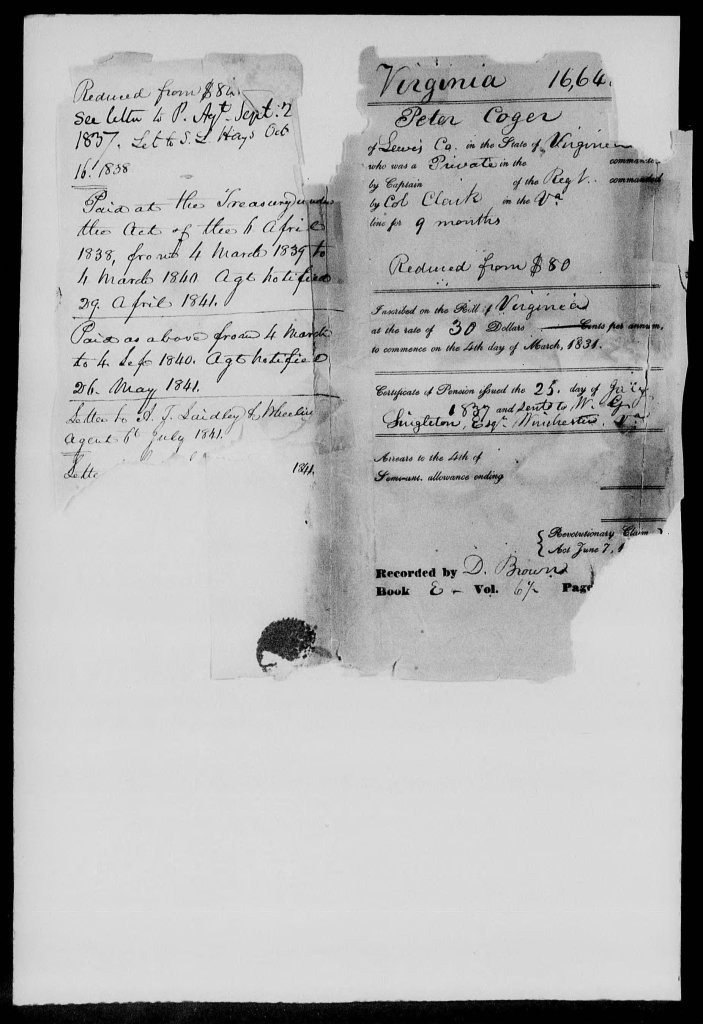
Pension Payout Form:
The second page in Peter’s file, indicating the process of paperwork in paying out his pension. I am still researching this, but the original amount awarded had been $80/year; it was then reduced to $30/year about two years later; I am unsure of the reason why, but perhaps because more had applied and were eligible then originally projected when the Act of Congress was passed in 1832. That might also by why the compilers of pensions were so ready to accept any testimony that someone was receiving a pension under fraudulent pretenses.
 Metes & Bounds:
who is the person who is actually a descendent of Peter Coger? My wife and I are in the process of writing a book called “Peter Coger – American Patriot.” I am a direct descendent of Peter’s brother Nicholas, son of Hans Jacob – who moved to Kentucky around 1796. One of my Koger cousins is a Peter Coger descendent and is doing research to try to and prove who his father really was. Two years ago, I travelled to Richmond VA for the Koger reunion and dressed up as Peter Coger and gave a 10 minute dramatic monologue.
LikeLike
My name is Jason Cogar. Someone did a lot of research on my side. Was able to see my family tree all the way back to Peter Cogar.
Godfrey Hambleton & Maria Elizabetha Koger (Wilhuet)
John Peter Cogar & Mary Cogar (McElwain)
Benjamin G. Cogar & Mary “Polly” Cogar (Hosey)
John Jehu Cogar & Caroline Cogar (Brooks)
Clark Cogar & Sarah J. Barnett
James Edward Cogar & Cary Carpenter
Daniel P. Cogar & Rachel Dix
James Edward Cogar & May Cogar
Jason James Cogar
LikeLike
Hello Jason,
this is also my family line!
I currently live in Virginia. Our family has many descendants in Webster County, West Virginia. Where do you live? Are you familiar with that part of West Virginia? Thanks, Shari Beale
LikeLike
I’m in North Carolina. My dad is from WV, he joined the USMC in 1967. I’m not familiar with WV. I’ve been in the Air Force for the past 21 years. I’m happy someone put out our family history. Thanks Jason Cogar.
LikeLike